
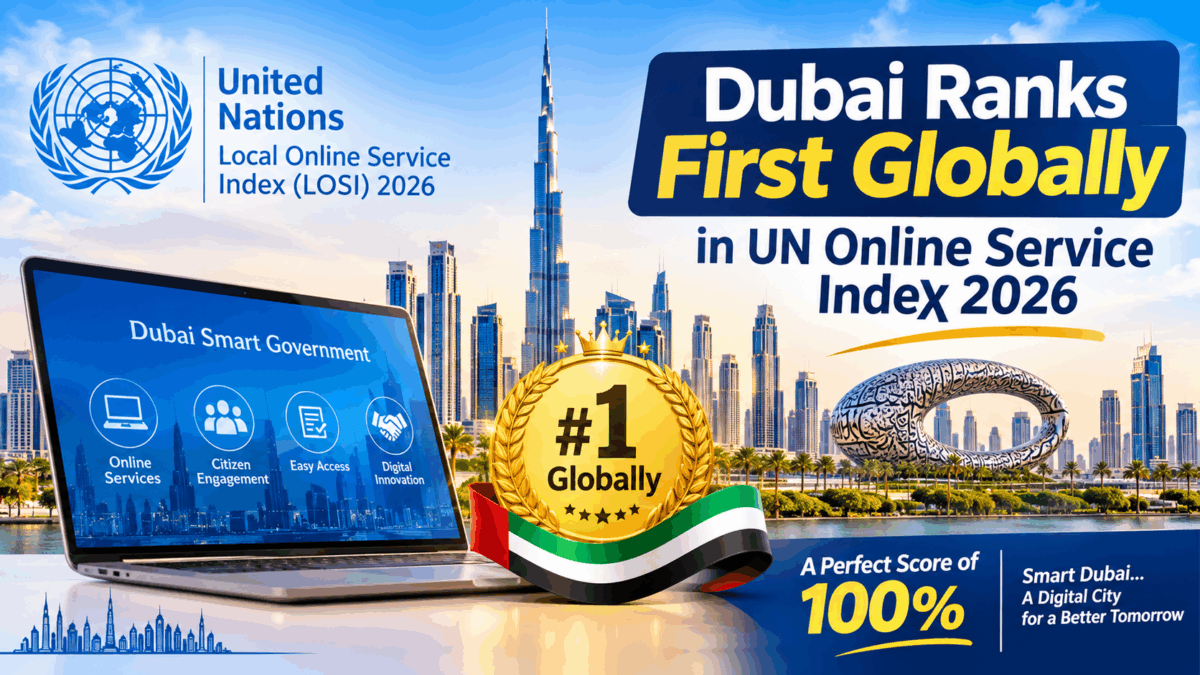
Dubai Ranks First Globally in UN Online Services Index 2026 With Perfect Score
Dubai has achieved another major international milestone by securing the top position in the United Nations Local Online Service Index (LOSI) 2026. The emirate received a perfect score of 100%, recognising its progress in digital government services, online public information and citizen engagement.
The latest recognition was announced on November 19, 2026, as part of the United Nations E-Government Survey 2026, published by the United Nations Department of Economic and Social Affairs (UN DESA).
This achievement highlights Dubai’s commitment to building a connected digital government where residents, visitors, businesses and investors can access government information and services more conveniently.
Dubai Achieves First Place in UN Local Online Service Index 2026
According to the 2026 UN assessment, Dubai achieved the highest Local Online Service Index score of 1.0000, equivalent to 100%.
However, Dubai shares the top position with five other international cities: Madrid, Manama, Riyadh, São Paulo and Vienna.
The recognition reflects the development of Dubai’s digital government ecosystem, supported by investments in technology, integrated government platforms, data infrastructure and accessible online services.
Dubai has made remarkable progress over the years. Its position improved from 16th globally in 2018 and 2020 to fifth in 2022, joint fourth in 2024 and first in the 2026 assessment.
What is the UN Local Online Service Index (LOSI)?
The Local Online Service Index is an international assessment conducted by the United Nations Department of Economic and Social Affairs.
It evaluates how effectively cities provide government information, online public services and opportunities for residents to participate in local governance.
The 2026 edition assessed 194 cities worldwide using 101 indicators across six major categories.
These categories help measure the quality, accessibility, reliability and overall development of digital government services.
Six Key Areas Evaluated in the LOSI 2026 Ranking
The United Nations assessed cities based on the following six areas:
1. Institutional Framework
This category examines the policies, regulations and legal frameworks supporting digital government services. It also considers privacy protection, access to information and open data policies.
2. Content Provision
This measures how effectively government websites provide essential public information, resources and guidance required by residents, businesses and other users.
3. Online Services Provision
The assessment examines the availability and accessibility of government services through digital platforms, including the ability to complete transactions online.
4. Participation and Engagement
This category focuses on opportunities for residents to communicate with government authorities, provide feedback and participate in local decision-making.
5. E-Government Infrastructure
This evaluates the technical quality of government portals, including website accessibility, reliability, navigation, functionality and user experience.
6. E-Government Literacy
This measures the availability of digital support, tools and initiatives that help different population groups access and use online government services.
Dubai’s Digital Government Transformation Over the Years
Dubai’s latest achievement is the result of more than two decades of investment in digital transformation and government service development.
The emirate has focused on creating a connected government ecosystem where different government entities can work together and deliver more convenient services.
Important developments supporting this progress include:
i) UAE PASS: A unified digital identity that supports secure access to participating government and private-sector services.
ii) Integrated Government Services: Greater coordination between government entities to simplify service access.
iii) Digital Infrastructure: Continued investment in technology, data systems and secure digital platforms.
iv) Proactive Services: Development of services designed to anticipate people’s requirements and reduce unnecessary procedures.
v) Digital Accessibility: Improving online access and support for different segments of the community.
These developments contribute to a smoother experience for residents, visitors, businesses and investors.
Dubai Plans to Move Towards AI-Powered Government Services
Dubai’s first-place ranking also supports its ambition to move towards an AI-native government model.
The 2026 UN E-Government Survey, titled From Digital Government to Agentic Government, highlights how artificial intelligence could transform the way public administrations operate.
Future AI-enabled government systems could help coordinate processes, understand user requirements and deliver more proactive services.
Dubai aims to build on its existing digital infrastructure, UAE PASS ecosystem and integrated government services to support this next stage of development.
However, responsible AI adoption will remain important. Data security, privacy, transparency, cybersecurity and human oversight are essential to ensuring that advanced technology benefits the public.
How Does Dubai’s Global Ranking Benefit Residents and Businesses?
Dubai’s recognition is more than an international ranking. It also highlights the potential benefits of an efficient digital government system.
Here are some important advantages:
- Convenient Government Services: Residents can access participating services through digital channels.
- Less Administrative Work: Integrated platforms can help simplify government procedures.
- Business Support: Accessible government information and online services can make it easier for businesses to navigate administrative requirements.
- Improved User Experience: Better digital platforms can reduce the need for unnecessary visits and paperwork.
- Greater Accessibility: Digital literacy initiatives can help more people benefit from online services.
The development of digital government services also supports Dubai’s wider ambitions to attract international businesses, investors and skilled professionals.
Dubai and Other Cities Share the Top Position in LOSI 2026
Dubai is among six cities that achieved the highest possible score in the 2026 Local Online Service Index.
| City | LOSI 2026 Score |
| Dubai, UAE | 1 |
| Madrid, Spain | 1 |
| Manama, Bahrain | 1 |
| Riyadh, Saudi Arabia | 1 |
| São Paulo, Brazil | 1 |
| Vienna, Austria | 1 |
All six cities share the top ranking, demonstrating the progress made by leading cities in digital public service delivery.
Frequently Asked Questions (FAQs)
1. Did Dubai rank first in the UN Online Services Index 2026?
- Yes. Dubai achieved the highest score of 1.0000 (100%) in the UN Local Online Service Index 2026, sharing first place with five other cities.
2. What is the UN Local Online Service Index?
- The Local Online Service Index (LOSI) is a United Nations assessment that measures the development and quality of online government services at city level.
3. What score did Dubai achieve in LOSI 2026?
- Dubai achieved a perfect score of 1.0000, equivalent to 100%.
4. Which cities share first place with Dubai?
- Madrid, Manama, Riyadh, São Paulo and Vienna also achieved the highest possible score in the 2026 assessment.
5. How many cities were assessed in the LOSI 2026?
- The 2026 assessment covered 194 cities worldwide and used 101 indicators across six evaluation categories.
6. What is Dubai’s next digital government goal?
- Dubai is working towards an AI-native government model that aims to deliver more integrated, proactive and responsive public services.
Final Thoughts
Dubai’s first-place achievement in the UN Local Online Service Index 2026 marks an important milestone in its digital transformation journey.
With a perfect score of 100%, the emirate has demonstrated the strength of its digital government ecosystem and its commitment to improving public service delivery.
As Dubai continues investing in artificial intelligence, integrated platforms and advanced digital infrastructure, residents and businesses can expect further developments in how government services are delivered.